

Preparing for a bike trip: the practical guide
Are you preparing for a bike trip? Has a friend talked to you about the satisfaction of a holiday spent on the saddle? Yet as you watch cyclists pass by your house, do you continue to think that it's too strenuous for you and that you could never do it?
Wrong! You too can pedal among the castles of the Loire, among the poppies of Holland, or even between Vienna and Budapest. These are not impossible adventures for supermen and women, but beautiful holidays that you too can do, with just a bit of preparation and a careful selection of the tour most suited to your level of difficulty (here we help you choose the tour based on your fitness level).
Know that you don't need a super light and high performance carbon bicycle. To start, all you need is a comfortable saddle, inflated wheels and any "iron" with pedals, we assure you and we are sure that even your bank account will thank you. If you get a taste for it, the world of cycling always offers new materials, new gadgets and technologies, so there will always be time for compulsive shopping. Not before, however, reading our advice on how to choose the right touring bike!
To prepare sufficiently and be confident to fully enjoy the holiday, we want to point out some particularly important aspects to consider.

Training
If you are new to cycling, the mere word "training" might scare you, because it makes you think of sweat, exertion and sacrifice, impossible climbs and pain to muscles unknown to you. But in reality, if you don't plan to ride hundreds of km a day, but want to enjoy landscapes, smells and tastes, then the word training simply means getting used to being in the saddle.
Fun
Unless you are professionals, always keep in mind that riding a bike should be a pleasure, a way to relax and relieve stress. This means that the effort should always be less than the pleasure of looking around and discovering new places. If a bike trip is too tiring to enjoy the scenery, it stops being a holiday and we want more than anything for you to have fun, which is why we carefully select our trips based on routes, stops and distances allowing you to never be too tired to enjoy a glass of wine during a stop, perhaps at the Vlissingen seafront in Belgium.
Graduality
Do not overdo it with efforts, especially in the beginning. Some trips are beautiful if you have a minimum of training, but they could become a bit too strenuous if you have never got on the saddle. If this is your first trip, enjoy the beautiful flat roads, there is always time to increase the difficulty!
Even during your Sunday outings don't overdo it. Don't get caught up in excitement and novelty, make sure to pace your stages according to your physical form. Graduality and fun also mean that if you don't feel like pedalling or you don't feel fit, then simply don't do it. Demanding performances from your body that it is not trained for leads to the opposite effect: you will have sore muscles, be tired and demotivated. To give you a yardstick, you should finish the hike, ride or training not when you are exhausted, but when you still want to keep pedalling. Only in this way will you be sure to want to get back on your bike the following week and not want to sell it.
Okay, but how do we prepare for the trip then? Don't worry, here are some useful tips.
Generally, in the cycling world, a "beginner" is someone who has never ridden more than 50km consecutively on a bike. This could be someone who is completely sedentary, but also someone who simply practices other sports.
A useful tool to measure the distances to cover is this formula:
Multiply the age by 0.3
Subtract from 40 the number obtained
The result will be the number of km to try to cover for your first outing
Example: if you are 50 years old. 50 x 0.3 = 1540-15 = 25 that is for your first outing try to do 25 km and, if you go out every Sunday, do not exceed this limit for the next 3 weeks.
If you can commute to work by bike sometimes, you will definitely notice improvements in your fitness and the serenity with which you will cover your 25 km Sunday bike ride. Then there's the satisfaction of overtaking cars stuck at the traffic lights on your bike?
Which muscles do we use?
Cycling means subjecting the muscles to a cyclical action of long duration. The muscles of the lower limbs, which naturally have the task of pushing on the pedals, are mainly at work, while the upper part of the body is engaged, in an isometric way, in maintaining our balance on the bike.
This means that there are a lot of activities that can be useful to train the body for the bike, notwithstanding that the best way to train, of course, is to pedal. Swimming, for example, is a great activity that tones the torso, the lower limbs and also provides excellent cardiovascular training, it is also very useful if you want to take a dip in the sea from the boat during a bike and boat holiday in Greece!
Going to the gym is of little use, unless you are followed by well-specialized trainers of course. Spinning or the treadmill can be useful for their aerobic function, but weight activities mainly tend to increase muscle mass and are therefore generally discouraged unless they are part of more complex and structured programs, but that's not our case. Even running can be useful, but if you are beginners be careful with your knees, the rules of graduality and fun apply here too.
And when we are in the saddle?
When we finally start pedalling, remember to correctly adjust the height of the saddle, even getting help from a specialized shop if needed. The saddle should be adjusted so that the legs are fully stretched at the end of the pedal stroke. We will not touch the ground, but we will be sure that our legs are working in the best possible way and we will not run the risk of inflaming tendons and joints.
Always start with great calm, the first 10-15 minutes are for our body to warm up and understand that we are doing a physical activity, so don't overdo it, always start off very calmly and only after the first 15 minutes, if you feel good, gradually increase the pace.
As soon as we start pedalling, it would be useful to become familiar with the gears and use light ratios (small chainrings in front and large sprockets in the back). The aim would be to have a "light", fluid pedalling, that does not cause us pain or fatigue in the legs. If we feel a "burning" sensation in our legs, it means that the ratio we are using is too hard and we should lighten it.
The goal we should aim for is what we see in cyclists who ride in groups: they move their legs smoothly, like clock hands, while keeping the torso perfectly still, without trunk oscillations.
Don't be in a hurry to tackle the slopes, get familiar with the bike, with the gears and find a fluid and comfortable stride that allows you to pedal for a long time during the first outings. Only after doing some rides, start trying the overpasses which, for length and slope can be tackled even by bikes without gear change and don't be afraid to stand up on the pedals if you can't make it. This is the first approach to real climbs where you can start to get familiar with the gear shift in order to try and lighten the pedalling as the gradient increases, so as to always keep it fluid.
If you want to evaluate your progress, try to retrace the same routes, so you can understand if that climb or that stretch that you found so strenuous, over time becomes increasingly feasible. These will be the first signs of improvement that will encourage you to gradually increase distances and difficulty. You will see that each time you will find it slightly less tiring and after a while you will wonder how it was possible to struggle so much the first time.
At the end of each ride, before treating yourself to the well-deserved beer, give your body 10-15 minutes of stretching, with some stretching exercises for legs, calves, neck and chest. This will allow you to keep your muscles elastic, reducing any pain the next day.
Always remember that cycle tourism is not a race and there is no room for competitiveness, so each of us will have to approach at our own pace and without rushing, after all even the greatest champions have won their races one pedal stroke at a time.
Ready for your first cycling adventure? On Cyclando you can find hundreds of easy bike tours and holidays, suitable even for those who are having their first cycle touring experience. Just choose the destination, set the filters to your fitness level and set off!


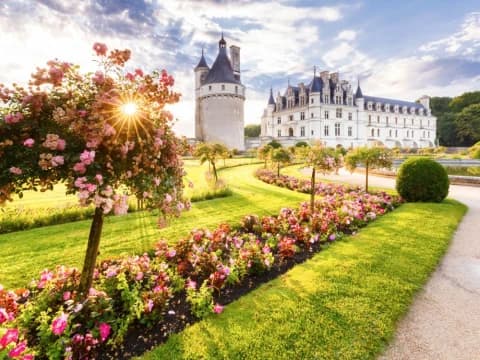

 France
 194km
194km

 7 days